Our Theory of Change
Contact Us / Donate NowWhy is making positive change in the delivery of human services so hard?
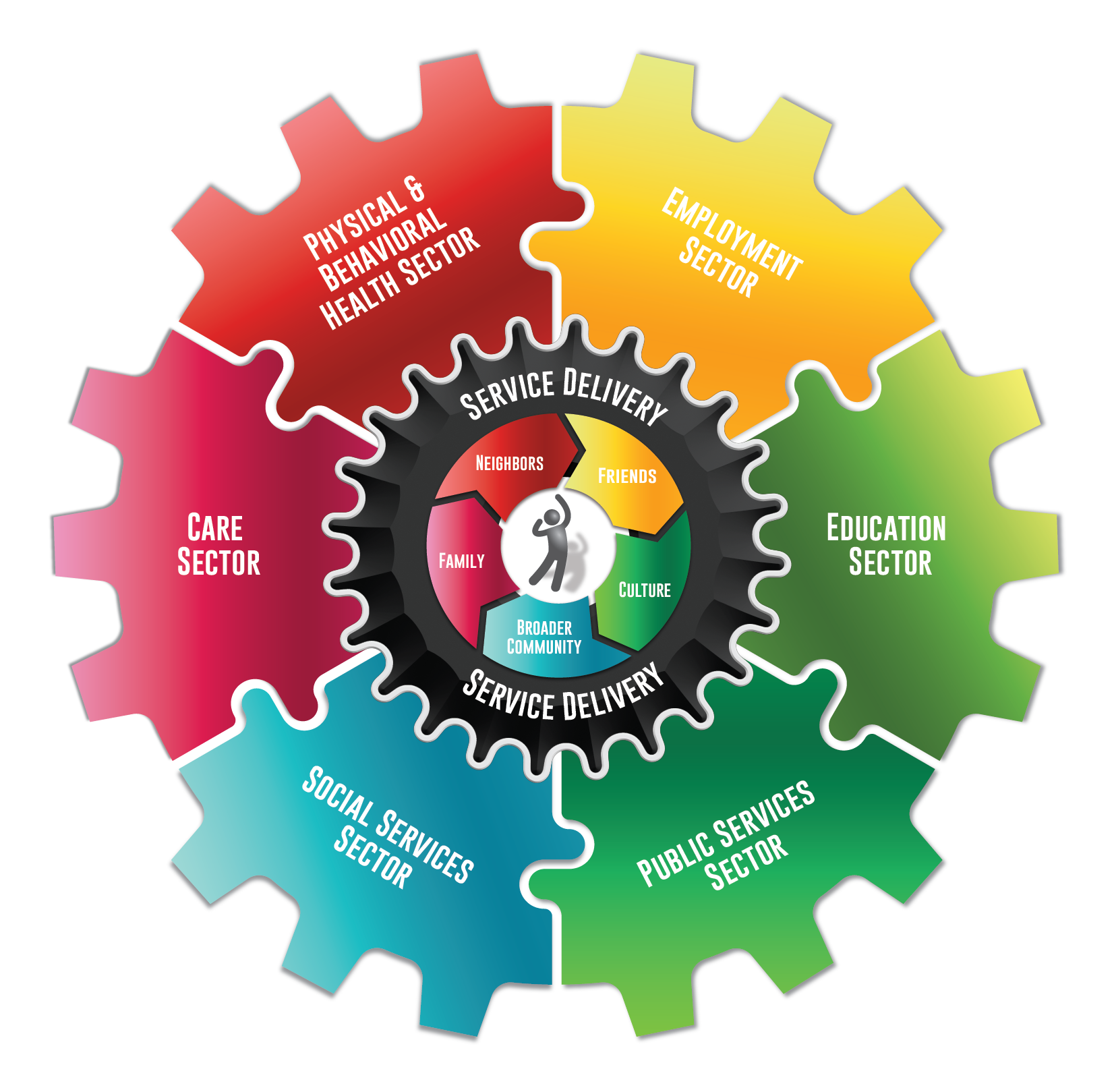
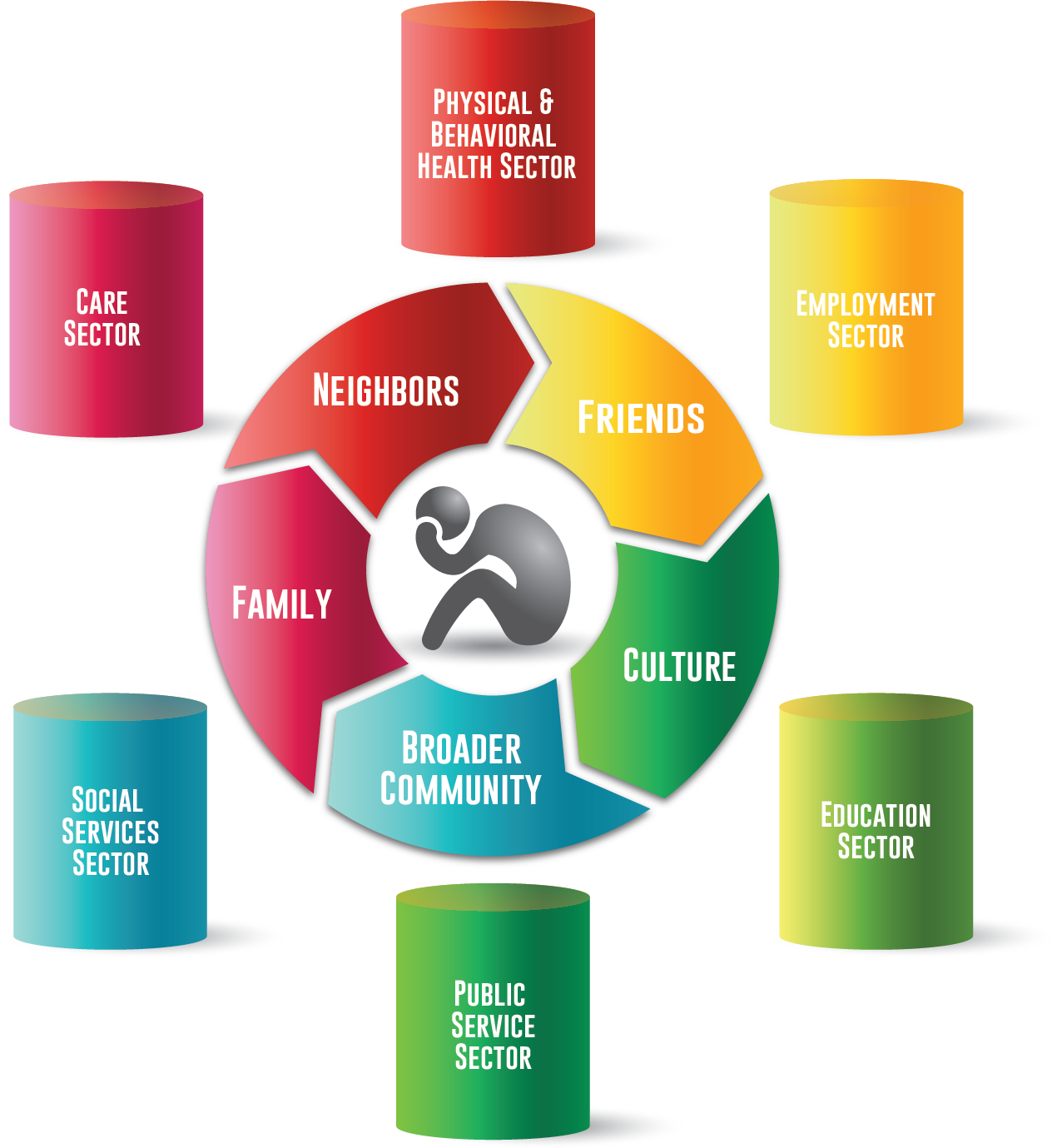
To answer that question, we look to Dr. Urie Bronfenbrenner’s ecological systems model, which illustrates that a person’s development is influenced by a complex ecosystem of environments and support systems, and pair it with Engel’s bio-psycho-social context.
At the center of all of it, is a person. Throughout life, that person’s development is supported and influenced by a personal network of family, friends and broader community.
That community of support is in turn supported by external agencies that provide human services.
At a macro level, sectors and government departments are created to efficiently create and manage policies, regulations, and systems.
At a micro level, programs within those sectors are developed to deliver those services, and are often augmented with private organizations (NGO’s, non-profits, etc).
But the management and delivery of our human services largely isn’t approached as an ecosystem, and too often the focus on the person/family at the center is lost.
Unsung and Underfunded Heroes
Public and private funding to support these augmented services is highly concentrated in a small percentage of nonprofits (based on 2023 Federal 990 data, 97% of the overall funding went to only 3% of the nonprofit community), while the majority are highly under resourced despite serving most of the population.
The super-funded nonprofits are larger, well established, and have brand recognition. Despite these advantages, they are degrees removed from the community and its needs and are only able to serve less than 10% of the overall population.
Most nonprofits are stuck in a scarcity model of fundraising, which disincentivizes collaboration. Current funding models perpetuate this system by prioritizing the larger, more established, nonprofits using their capacity as a proxy for effectiveness, longevity as a proxy for impact, and brand recognition as a proxy for trust.
And yet, research is clear that local led interventions that are cross-sector in their approach produce the best results.
Ironically, it is the local under-funded organizations that are closest to the individual at the core of the ecological model that are best positioned to bring about meaningful change.
In Summary, systems struggle and lose sight of the collective purpose because:
- They are complex
- They are siloed
- Those most meeting the need are under-resourced
- Collaboration and coordination is not incentivized
Lack of coordination between sectors leads to inefficiencies at best, and at worst services can be contraindicated.
The Problem
A Better Approach
But what if we approached care in a more coordinated way? What if we managed the delivery of our care from a more holistic and ecological perspective?
What if we empowered those unsung and underfunded heroes and provided them the supports and funding that undergird the super-funded organizations?
Collective Impact Strategies
We work with those underfunded organizations and focus on the intersections of desperate sectors, knowing that siloes of sectors is part of the problem.
We build collaborations of organizations focused on:
Building COMMUNITY – enabling organizations to learn from one another, support each other, and grow their connections to other members of the collaborative, other outside organizations and governmental entities that position them to be more effective partners.
Promoting COORDINATION – helping the Collaborative to see the connectivity and alignment between their work, across sectors to help break down the silos that plague current human service systems, and within sectors to flip the competition mindset and replace it with a more collaborative one to serve people more effectively.
Growing CAPACITY – working together to compound the capabilities of assets, skills and resources across the entirety of the Collaborative. Additionally, seeking out, pursuing, and then managing the implementation of new funding sources that enable multiple organizations to work together collectively.
We see the CONNECTIONS and serve as guides toward helping others to as well – leading to improved human service systems that benefit people – and when people are thriving, so is society.
Our ecological systems approach encourages us to work in many areas, across disciplines and fields, so long as the connective tissue is a focus on improving people’s lives. Through education. Through employment. Through healthier and happy lives – all with a commitment to affecting these changes broadly and equitably to benefit all.
When approached human services in this more holistic manner,
- Most importantly, we find that the person at the center receives better “wrap around” care.
- Resources can be braided together, increasing efficiency.
- Opportunities are revealed for delivery services to work collaboratively instead of competitively, improving the overall efficacy of those services.
- Moves the field from a mindset of scarcity to abundance.
The Solution